19 July 2009

New blog


For new posts by Fiona, please visit anhelando el cielo

© Fiona L Cooper 2009

09 July 2009

The Last Post

As of Friday 3rd July, I no longer work at FEISA.

A number of funding difficulties at FEISA have led the Anglican Church in Paraguay (the body financially responsible for FEISA) to carry out a restructuring of the institution. As part of that restructuring, several jobs have been eliminated and mine was one of them.

I feel privileged to have been part of FEISA for these three and a half years. I have worked with some very inspiring people. In particular, I have been captivated by Ana's dynamic vision, embraced by Noemí's gentle spirit and humbled by Sam's generous heart. Then there's Susi, who has such a great sense of humour, and Esteban, whose faith knows no bounds... I have had so very many meetings which have been peppered with raucous laughter, because of knowing each other well and having a shared joy in life. It has been such a wonderful blessing to be part of such a dynamic team and I am definitely going to miss the working atmosphere.

It has been an honour to be part of FEISA's vision; to hear testimonies of how our graduates have impacted the lives of children, bringing God's love into their classrooms. I have enjoyed pouring my experience into the students' teaching through my observations of them on teaching practice. It has been great to be part of the process of awarding scholarships to the most economically needy students, thereby giving them a helping hand out of the poverty cycle as well as helping them fulfill their vocation. I have been pleased to use my experience to enrich the curriculum for training the students how to teach English to young children. I have derived much joy from watching the students progress in my English classes.

One of my greatest pleasures has been to pass on my knowledge of how to teach English to young children to qualified teachers through my Fun English workshops. I have even had the opportunity to meet with some of these teachers at later dates and they have told me of their delight in using my ideas and materials. "The children love it," one teacher told me. There is no greater accolade in my book!

I am completely amazed by the way God has been leading me through my life. When I was preparing to come to Paraguay and work at FEISA, I could clearly see how the work I was expecting to do here was the culmination of all the work experience I had had up until that point. I could not imagine life after FEISA because I couldn't see how there could be another job that would fit me anywhere near as well, given my background.

Now, however, I can see that even this time at FEISA has been preparing me for something else, something new, something better. I have learned so much during my time in FEISA, and one of the most surprising things is that I enjoy writing and might even have a gift for it. Because of this, I'm not going home just yet. The SIM leadership here in Paraguay have asked me to do some writing projects for the team so even though my work at FEISA is done, I am going to stay here for the next few months. I am looking forward to this new challenge and excited about what the longer-term future may hold.


This is the final post on this blog. If you want to continue to read about what I'm up to, my new blog is anhelando el cielo ("longing for heaven")


© Fiona L Cooper 2009

01 July 2009

FEISA Graduates

FEISA's vision is to train early years teachers to the highest standard in order to develop in children their full potential and so generate a transformation of society.  Our graduates are working in many different contexts.  Some of them are at the frontline of the struggle to transform Paraguay by giving children from disadvantaged backgrounds access to high quality education.  Here are some of their stories:


Anabel graduated in 2003 and now works for a government project aiming to tackle the huge numbers of children working on the streets in Asunción and surrounding towns.  The project works with the families to eliminate the need for the children to work by helping the parents generate sufficient income.  It also provides health, nutrition and educational support.  Of the 1,340 children being supported by the project, 96% are no longer working on the streets.  Annabel is completely fulfilled in her work. “I always knew I wanted to reach more than the children in one class. These children are vulnerable and isolated. Nothing was being done for them. To see the success of the project and know that this is possible for more and more children in Paraguay thrills me.”


Lili graduated in 2004 and now works with the indigenous Aché community.  Educational provision amongst indigenous communities is the worst in Paraguay and it is difficult to find teachers for these communities due to the harsh living conditions.  Lili’s dynamic, interactive teaching methods in pre-school made even the youngest children want to attend so she decided to start a nursery class as well! The community is delighted that their children are learning so much. Her teaching about basic hygiene is also ensuring better health for them and their families. Had Lili not received a full scholarship from FEISA, she would not be teaching today.


Silvia graduated in 2004 and now teaches in a day nursery run by a Mennonite charity.  As well as having a class of 25 four-year-olds, she co-ordinates the volunteers who work with all the children, aged from 6 months to 5 years.  The charity’s vision is to offer economic, social and spiritual help to disadvantaged families, most of whom come from shanty towns.  They wash, feed, educate and provide basic medical care for the children and they provide talks and workshops for the parents on parenting and life skills.  Silvia is now studying for the degree at FEISA and she says she’s learning an enormous amount.  She says, “My whole life I have wanted to be a teacher.  FEISA gave me very good training, which prepared me well for the job.  Now my desire is to become the director of a Christian school.  Doing the degree is the first step.  This is my vocation.”


Elisa graduated in 2006 and is now teaching in a charity-run school for children at risk.  She has a class of 23 five-year-olds, all of whom come from families where the parents are either in prison, working on the street or ill, often with AIDS.  She acts as nurse and mother as well as teacher to these very needy children.  Before she came to FEISA she felt called by God to work with young children, but did not have the economic means to pay for teacher training.  By offering her a scholarship, FEISA gave her the opportunity to qualify as a teacher and she says it was a dream come true for her to be able to study, a real gift from God.  She now feels fulfilled in her work; “I feel useful and I’ve got so much to give.  I try to make a difference to the children’s lives, giving them the love and attention they need.”

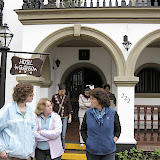
© Fiona L Cooper/FEISA 2009

12 June 2009

Aim Lower, Think Smaller...

"How to Not Mess Up the Great Commission Too Much"

This video was shown to us at the end of the conference in Lima. It really demonstrates the high priority children's ministry should have, the world over:


© Fiona L Cooper 2009

11 June 2009

SIM Children's Ministry Conference


We gathered together from different countries in South America, with one purpose; to enrich our ministries amongst the children of our continent. From Peru, Ecuador, Chile and Paraguay came national children's workers and missionaries, to learn from the wisdom and experience of Betty and David Constance, our speakers for the week. We met in a lovely old hotel in Lima, under the grey skies of approaching winter, the last week of May 2009. 

Betty and David opened up the Bible to show us more deeply God's passion for children and drew from their vast experience to teach us how better to minister to those who are hurting. We could all identify children who had been through distressing experiences and Betty revealed the importance of not just containing the difficult behaviour that often results, but of finding out its root cause and helping the child come to terms with their pain. It was a real joy to listen to Betty express her passion for children and to hear the way the Lord has equipped her over the years to minister to children who were living difficult circumstances. Her talks were also packed full of practical advice for us, so we came away with ideas for helping children we knew.

I enjoyed hearing from all the participants the different ways God is using his church in South America to give children hope and show them God's love. We had plenty of time to fellowship together outside the formal sessions and the conversations over coffee and at meal times were particularly rewarding, as we discovered the things we had in common and the differences between us. There were tears at times, but there was also much laughter as we began to get to know each other.

I feel very privileged to have participated in this SIM gathering: I learned a lot, but mostly I think it did my soul a lot of good to spend time with these special people, all of whom love God and seek to share that love with children.

See more photos:

Lima - Mayo 2009


Adapted from an article written for the SIM Crucial Moments newsletter
© SIM and Fiona L Cooper 2009

15 May 2009

Ted Dekker on Christianity

Ted Dekker has written a blog post about his perspectives on Christianity. It explains neatly how I feel about my faith too:

SCOURGE OF THE EARTH or compassionate lovers of human kind? Depending on where you live and what your experience is, Christians may be identified as either one, and, much to the chagrin of those who use the label to describe themselves, legitimately so. It all boils down to what you mean by the label ‘Christian.’

Regardless of what we think any particular word should mean, it actually means what society interprets it to mean. Linguistics 101. Like the word gay. I’ve been quoted as saying that I could have once properly been branded the gay author because, although I have always been heterosexual, I once was… well, gay. Twenty years ago the word meant happy. Today it refers to sexual orientation. So although I was once gay, I am no longer gay, not because I’ve changed, but because the understanding of the word in society has changed and it no longer describes what I am.
So it is with the word ‘Christian.’

Jesus summed up his message as follows: Love the Lord your God with all your heart and love your neighbor as yourself. Armed with this simple mandate of love, millions of his followers have forsaken the relative safety and affluence of a comfortable life to extend love and hope to the downtrodden over the centuries. Much could be said to explain how and why Christianity has embodied compassion in a world torn by war, terror, and heartache. It’s all about love, my friend. They may hate you for your love because to the guilty love sometimes feels like salt in a wound, but they will still know that you are Christian by your love.

Unfortunately, in the eyes of many, Christianity is now far better known for much more and much less than love. Not all of the associations are bad, mind you, but they are a far cry from the message of love that ultimately cost Jesus his life. Ask any pedestrian and, depending on where they live, they will tell you who Christians are. (read the whole article)


© Fiona L Cooper 2009

25 April 2009

Oh Dear...

More revelations about Lugo's past... see the BBC articles below:

19 April 2009

Besos (the joys and pitfalls of greetings in Paraguay)


One of the aspects to living in a Latin culture that sometimes takes a bit of getting used to for those from more reserved parts of the world is the touchy-feely nature of greetings. You have to get up close and personal!

In Paraguay that means, as a woman, you get to kiss other women on both cheeks and shake hands with the men (and in more familiar settings, you kiss the men too). The kissing can feel like a bit of an invasion of personal space if you're not used to it. Fortunately, I've had enough cross-cultural experience in different countries to have become accustomed. And in fact, it's one aspect of the culture I really appreciate. I love the fact that you're committing yourself to saying hello to someone enough to actually get that close to them. You're taking a bit more time to greet them than the quick "hi" that would suffice in our cooler climes. It's also very hard to kiss someone with a frown on your face or bitterness in your heart, so for those brief moments you put aside your differences and treat each other as human beings.

It feels like a social leveller somehow - it doesn't matter who you are, or where you're from, whether you're rich, poor, fashionable, frumpy, fat, thin, tall or short. You share the same physical space for a second or two and you can't help but feel some kind of sympathy towards the other person, even if only fleetingly. In a way, you're both being vulnerable, which is a good thing, and also sharing touch, which we all need, but which we in the UK at least, tend to lose out on because of our strict views of personal space.

The kissing is not just something you do the first time you meet, it generally happens every time you see each other, at least on social occasions (it doesn't happen every day at work). It is seen as a slight if you greet one person this way in the presence of another, and fail to give the second person the same consideration. It can prove quite a danger to public relations if you miss someone out. In the three years I've been here, I've never quite managed to feel so comfortable in these social situations as to know exactly what's expected, and you've really got to commit yourself because it's either kiss everyone or kiss no-one... so I tend to wait for someone else to give me a clue, while my default position is usually a big smile and a general, "Hola!"

In the physical act of the kiss, what normally happens is that you both touch fleshy cheek to fleshy cheek. In effect, your cheeks touch and your lips kiss the air. However, there are the people who throw their head so far to the side that they end up offering you their ear rather than their cheek! Then there are those who keep their head still while you do all the moving from one side to the other, rather like a duck. Finally, there are those who actually kiss their lips to your cheek, which leaves your lips kind of hanging in the air, as it were.

But any confusion or awkwardness in these situations pales in comparison to that felt by foreigners new to the country or just visiting. These poor souls are often accosted by Paraguayans and/or long-term ex-pats, who are so used to the custom that they are half way to the visitor's face before the poor thing realises what's going on.

Yet by far the most awkward circumstances I find are those among long-term ex-pats, who are accustomed to greeting nationals in this way, yet are aware that in their home culture, it wouldn't be at all appropriate, and so the question is; do we kiss, hug, shake hands or just give a wave from across the room? More often than not, I find that one person is going for the hug, while the other aims for the kiss. This turns into a cross between a very non-comittal hug, which ends at the cheek, and a rather over-committed kiss, which ends up around about the ear or neck. I have taken to announcing what I'm going to do as I lean in, in an attempt to avoid as much confusion as possible! Thus, on arriving last at a social gathering of ex-pats recently, I announced to the room that I would be doing the Paraguayan kiss and proceeded to make sure I'd "hit" everyone before I sat down to talk. And sometimes, I'll call out "Hug!" as I'm moving in, just so that the other person knows where they stand and what to expect. I've definitely found it the most effective remedy to cut down on those awkward half-hug moments, though I must admit to reserving the strategy for greeting friends, as I imagine those who don't know me so well coming away with a rather bizarre impression of my apparent need to announce all physical actions beforehand!

I'd love to hear any stories you may have of awkward cross-cultural greeting situations!


© Fiona L Cooper 2009

15 April 2009

Celibacy, the Priesthood and Paraguay

I've been pondering the subject of celibacy since Lugo's admission on Monday of fathering a child while he was a Catholic bishop (see previous post). Priests in the Catholic church are committed to celibacy. Yet there are so very many stories of priests who have affairs, and others who abuse boys, that I wonder just what proportion of the priesthood do actually make it to the end of their life without breaking their vow of celibacy. Is it the majority or the minority who do manage it? How helpful is it really to require such a vow, when it is broken so frequently? If it is assumed that a priest is above the normal human urge for sex, then that may free parishioners to be honest with their confessor in a way they might not otherwise. However, it is clear that priests are just as human as the rest of us, and in no way are they above such urges, so perhaps parishioners are unwittingly putting their clergy in positions of unbearable temptation... if indeed they do believe priests are super human in this regard. If, however, it is not assumed that a priest is above the human urge for sex, then surely the priest himself as well as the laity in a parish should be more than conscientious about not placing him in situations where temptation could become unbearable.

Lugo started his affair with the mother of his child when he used to stay in the house where she was living, as a 16-year-old girl. Obviously I have no idea how the affair started, but surely somebody should have thought of the possible danger it might pose to have a priest (a single man with all the normal sexual desires of any man) staying in the same house as a girl of that age? Should there not have been some kind of chaperone at the very least, to ensure they were never alone together? The adults around ought to have taken responsibility for the girl and protected her from being in a position where the then bishop could take advantage. Not that I'm assuming the seduction was all Lugo's. I can quite see it possible that she might have been the initiator - we just don't know, but at the age of 16, she should have had someone looking out for her best interests. And those best interests could never have included becoming a bishop's mistress. Surely?

However, Paraguay has a very relaxed attitude towards sex. It is so common to sleep around or to have a wife/husband as well as a bit on the side, that everyone sees it as more or less de rigueur. Perhaps I'm exaggerating, but I'm constantly surprised by the stories I hear of unmarried pregnancies and affairs. Unfortunately, the Christian community in Paraguay is also full of this sort of behaviour. There is a theory that after the Triple Alliance War in the 1800s, the male population of the country was so badly decimated that there weren't enough men to go round. Therefore, it became common to have more than one "wife," each in a different town. The theory is that this promiscuity has become embedded in the culture in a way that makes it extraordinarily difficult for Paraguayans to stand firm in the face of temptation.

The "scandal" of Lugo fathering a child while a bishop seems not to bother the average Paraguayan. On the contrary, the men would seem to be somewhat supportive of this proof of his manhood, while the women seem to be glad enough that here is a father who will actually acknowledge his illegitimate child.

It makes me wonder whether, given this prevailing attitude, those who were looking after this young 16 year old, perhaps didn't focus on the questionable morality of her affair with Lugo as much as the possible prestige and access to power that might come with her having a relationship with the bishop. Or maybe I've been reading too much Philippa Gregory (see The Other Boleyn Girl, where the court of Henry VIII was intent on gaining favour with the king by having young female relatives sleep with him...)!


© Fiona L Cooper 2009

13 April 2009

Lugo - Just A Man After All

I am dismayed to discover that the new President of Paraguay, Fernando Lugo, has admitted to fathering a child while he was a (Catholic) bishop.

The accusation was made last week by the child's mother and when I saw the headlines, I imagined it to be a plot by the opposition to attack the government. You know, find a girl who's got a child and pay her to go to the papers with her "story." The President will deny it so demand a DNA test, which he will also deny because he will not "dignify" the allegations. Meanwhile, the rumours fly around... Cause maximum disruption with the result of destabilizing the government.

However, the child's mother didn't go to the papers but to the police, with a seven-page written demand that the President formally recognise his son.

And today, Lugo held a press conference where he admitted to having a relationship with this girl and fathering her child. The child is now two years old and his mother 26. She says the relationship started when she was 16 and living in the house where Lugo sometimes stayed while carrying out his duties as Bishop.

I am deeply saddened by this news. I have lost a good deal of my admiration for him - he clearly does not have the integrity I thought he did.

However, he is neither the first president to have fathered a child out of wedlock before coming to power, nor is he the first priest to have done so.

I do admire his honesty at coming clean. The papers over the weekend were full of quotes by his spokespeople about how ridiculous an accusation it was and how they were going to fight it tooth and nail. I think it says an awful lot about him that he denied nothing and spoke with absolute candour at the press conference.

I imagine this honest admission will defuse a situation which could have become a destabilising factor for the government.

It is undoubtedly refreshing to see a politician admit so openly to wrongdoing. So my sadness is tempered by admiration... The public seems to be generally supportive of the fact he has come clean, which in Paraguay is somewhat refreshing (see this video).

For me, this subject raises the question of whether it really is good for Catholic clergy to take a vow of celibacy. It is clearly a vow extremely difficult to keep in practice. Would it not be better to allow them to marry, like Paul says in 1 Cor 7:8-9; "Now to the unmarried and the widows I say: It is good for them to stay unmarried, as I am. But if they cannot control themselves, they should marry, for it is better to marry than to burn with passion."


© Fiona L Cooper 2009

07 March 2009

Technology- friend or foe?


Technology. It's a huge blessing in my life. I can get in touch with my friends and family thousands of miles away in an instant. There is an enormous, seemingly infinite library of information on the web, which means I never have to wonder for long about something without being able to find the answer, or at least, someone's interpretation of the answer. I can buy things without leaving my living room, and have them delivered to my door, or someone else's door. Even better, I can buy music which gets delivered direct to my computer. I need do no more than click on the appropriate "button."

And yet I wonder just how good it is for me.

By getting me used to having whatever I want as soon as I realise I want it, it affects me negatively in a number of ways:

It somehow justifies my innate impatience. If the internet connection is slow today, I get overly frustrated and annoyed. This spills over into real life too, so the times I have to wait for things to be done, or finished, or given to me become intolerable and make me grouchy.

It feeds my greed. If I can get it so easily, why should I deny myself? My self-control goes out the window. Especially, in my case, with music - at only 79p a song on iTunes, it doesn't feel as though I'm spending very much at any one time. It soon builds up, of course.

This, in turn, leads me to appreciate less what I already have. I'm suddenly excited about having the newest thing, and I neglect the things I already have. So whether I'm buying a book or music, I focus on the new and stop listening to/reading my older collection.

iTunes

I have 2000 songs in my iTunes library. How often do I listen to any one of them? Not often. I really do tend to listen again and again to the album or song I bought most recently, until I'm sick of hearing it, or it loses its impact. Then something else that's new catches my attention, or I go back to something older from my collection. But with 2000 songs to choose from, I really do lose perspective and sometimes find myself lost for something to listen to. I have been known to start listening to one album then realise it's not really what I want to hear at the moment, so I go find something else, but then that doesn't really do it for me either... In the old days, with records, tapes or even CDs, I would either have spent longer on the choosing or would have been happier with my choice. But because I'm so used to instant gratification, I'm unimpressed if there's a song I don't absolutely LOVE.

One of the great things about iTunes is that you can make up your own "playlists" so you can select the songs from different albums you like and put them together. Yet this also makes me much more impatient with the music. If I only ever listen to things I really really like, is that really good for me? In my own little world, I don't ever have to put up with anything less than wonderful. And I wonder whether I'm becoming more and more set in my ways and protective of my own little bubble and maybe actually it would be very good for me not to live on my own for a while...

And then there's Facebook.

I admit to having a love-hate relationship with this social networking thing. So, you put your picture on it, add some personal information and then collect Facebook friends. Then you add applications, which can be games to play with others, campaigns to join, vehicles for expressing yourself or creative ways of describing yourself (Which Disney character are you? Which flower are you?) And then what? You get to keep in touch with all your friends. Hmm. These would be the same friends you see at work, or the ones you normally email, or folk at church... The same people, in fact, that you see or are in touch with anyway.

Okay, there are some people I have got in contact with who I haven't seen for a long time, and at first, it's really great to "see" them. However, mostly they are people I have lost touch with because we don't have much in common any more. So they stay a "friend" and whenever I want, I can look at their profile and find out what they're up to... but there is no further communication between us. Is that relationship? Not really. So why bother then? Maybe I'm just having a "grumpy old woman" day. I do, after all, have a giggle at some of the things people write on Facebook. But even so, is my life really that much richer for it? Hmmm.

We live in a world where the expectation is for instant communication and instant gratification. I'm wondering whether we are losing an appreciation for well-thought-out correspondence here in email land. When we had to write a letter and post it and wait days for the reply, we would spend time composing it. Now we have a thought and we send it off into the ether without a second thought. I'm also wondering whether we are losing an appreciation for deeper relationships. All this Facebooking is very surface stuff and, while it may serve to keep a relationship on a certain level, it certainly doesn't develop it any further. But shouldn't real relationships should be constantly growing and deepening?

I do believe that we are losing an appreciation of the things we have when it is so easy to acquire more. And that is a dangerous thing. It encourages in us a dissatisfaction with what we have, because there's always something newer, if not better, out there. And that has to have an effect on our general attitude towards life. If others can have it, what's to stop me from getting it? And so, during the times when my life is hard work, and the world is shouting its wares at me; "happiness can be yours if you eat enough ice cream/have enough sex/fill your home with enough technology..." of course it's going to be a lot harder to resist the lure of the lies. If we give in to this mindset of having what we want whenever we want it in the realms of communication, information and online purchasing, then we will easily be sucked into having that same attitude in the rest of our lives.

So let's be careful not to always give in to the urge. Let's take a moment to think whether we really need to know that fact/buy that product/write that email. And let's bring God into all our decisions, whether big or small, so that his love and grace and peace permeate our lives and we live each day a little more faithfully to the ideals of the Kingdom of Heaven.

And I shall start with me.

© Fiona L Cooper 2009

01 March 2009

Training Teachers in the Chaco

The river Paraguay splits this land-locked country in two: The eastern half is lush and fertile, while the western half is a dry, flat and harsh region they call the Chaco.

There are indigenous communities in both parts of the country, speaking a variety of languages. FEISA has had links for a number of years with indigenous communities in one particular part of the Chaco. The college has run several training programmes with teachers and mothers to improve education for the under-fives. All these programmes have come at the request of the communities themselves, who are largely neglected by the national government when it comes to useful and practical training and resources for teachers.

The mother tongue of most of these communities is Enxet, but the schools haven't had resources to teach in Enxet, so the children have been doing much of their learning in Guaraní, or Spanish. FEISA realised the importance of encouraging the use of Enxet in school, in order to preserve the language for future generations, and has been translating the teaching resources developed for indigenous Paraguayan contexts into this language over the past year or so.

This weekend, I had the privilege of accompanying a FEISA training visit to the Chaco, where the teachers, some of whom speak Spanish, but most either Guaraní or Enxet, were taught games, songs and other activities to do with their young pupils in their mother tongue.

I had the job of taking photos, which made me very happy! So do go see them, if you're interested:


Chaco visit FEISA training session


© Fiona L Cooper 2009

14 February 2009

Successful "Fun English" Workshop

Following on from the success of my workshop erm, two years ago (!) I once again offered my wisdom and experience to any and all teachers who were interested in teaching young children English in a creative and fun way.

We'd done the publicity for the workshop, and asked people to sign up if they were interested, so that we knew how many people to expect. By yesterday evening, we had a grand total of 9 teachers signed up. It wasn't a huge number, but I didn't mind - I figured if God wanted just a small number to come then that was his prerogative and I would give it my best for those few. By the time the workshop started this morning, there were 14 teachers, and four more appeared over the next half hour or so... In the end, I had twice the number of people I was expecting. It was wonderful to see so much enthusiasm! Most of the participants also bought my book and the CDs of songs and resources. Hooray!

I had a great time once again - I love helping others become more creative in their teaching and it's a wonderful privilege to be able to pass on what I've learnt to people who are keen to do the best they can. Oh, and I love the whole "performance" aspect of teaching anyway, and with such a willing group, it was a joy to encourage them to sing and play games with the eagerness of children!


Here's a wee look at what I do:


And you'll find some photos here:

Fun English Workshop 2009


© Fiona L Cooper 2009

09 February 2009

Flying visit to Iguazú

This weekend just gone I went with 3 colleagues to Iguazú Falls on the Brazil/Argentina border, to the East of Paraguay. It was great fun and the weather was beautiful. The rivers were high so there was a lot of water coming over the falls and it was awe-inspiring to experience all that stunning scenery. We saw some beautiful butterflies, interesting birds and even a group of monkeys who were navigating the trees above our heads.

Have a look at the monkeys:


And some of my better photos:


Iguazu Falls Feb 09


© Fiona L Cooper 2009

27 January 2009

Disasters Emergency Committee appeal for Gaza

The BBC has refused to air the Disasters Emergency Committee appeal for aid for the humanitarian crisis in Gaza. The broadcasters say it will compromise their impartiality. A respected politician, Tony Benn, says the BBC is bowing to pressure from the Israeli government. I think that the appeal for help has nothing to do with politics. The fact is, there are people dying, people without homes, without food, without water. Is that not enough on its own, regardless of the debate about why this is the case, to ask people who have money to donate some of it to help their fellow human beings in need?

Read the BBC's reasons here
Watch Tony Benn's response here
Find an article criticising the BBC's decision here

In an effort to counteract the effect of the BBC's refusal to air the appeal, here it is:


© Fiona L Cooper 2009

26 January 2009

Transition Blues

I went home for Christmas. I only told a very few people because I knew I wouldn't have time to see anyone else. I was in the UK for a month. I spent Christmas with my family in Newcastle, had a couple of wonderful days in the Lakes with a friend for Hogmanay and briefly saw other friends on my way down south to Heathrow and the journey back to Paraguay.

Now I'm back in Paraguay, where I belong for this time in my life and I'm feeling rather emotionally vulnerable. Which is unusual for me, being more of a logical than emotional personality type. And because of its unusualness, it's a rather uncomfortable place to be.

It's called Transition, this time between cultures, when you don't quite feel as though you fit anywhere. And it's what I'm going through. And I hate it. I've gone through it so many times in my life and recently, it's been every year. Yet it doesn't get any easier.

I think there are a number of factors which can make it easier or harder to cope with, such as how much I've enjoyed my time in the first culture, how much I miss friends and family, how settled I feel in the second culture, how much rest I've had recently, etc.

This time at home, I spent very good times with friends and family and I'm finding it quite hard that I can't spend more time with them, or see them more regularly. My friends have growing families - let me tell you about the 12 people I know who are pregnant at the moment!! - and I would love to be more a part of their lives, I particularly miss getting to know the children while they are young.

I've come back to what is very likely (though not definitely) my last year here in Paraguay. That means I'm inevitably thinking about the future beyond 2009 - where will I go? What will I do? This in turn makes me feel a bit restless about being here at all. I'm trying hard to focus on the here and now, but part of me is constantly evaluating what's going on, in an effort to discern which direction I should go in next.

I've returned to a job which, to all intents and purposes, is likely to be very similar in roles and responsibilities as it was last year. Last year was very hard and I'm expecting it to be a similar challenge this year. That doesn't exactly fill me with joy! Although the fact that I am convinced I'm in the right place for this time in my life does give me a certain functional contentment. However, being a details person means I often find it hard to notice the big picture and remember the reason I came when my mind is occupied with the nitty gritty of getting through the problem in front of me at the time.

So I'm generally a bit fed up and unmotivated at the moment. I'm also tired and the heat is affecting me more than usual because of that. I need to remember that this is a phase that will pass. I need to focus on the positives about being here and take time to enjoy them. I need to make sure I get enough rest, while being aware that sleeping too much is also a sign of stress. And I need to be able to talk about how I'm feeling. So thank you, because that's what this post has really been about - being able to articulate how I'm feeling in an effort to manage this horrid Transition process a bit better.

See more photos from my time in the UK:

Christmas break 08-09


© Fiona L Cooper 2009

14 January 2009

God in the unknown

I recently got an email from a dear friend, about searching for God's will. I wanted to share her beautiful and encouraging words:

"Who wants what God does not? I don't. Only His perfect will will do!! Right? So, back to the beautiful place of waiting in wonder for that very will to unfold."

"God makes all things beautiful in His own time. God's ways are perfect and if you sit with an unknown future blinking back at you, just rest and He will make the empty nothingness beautiful. But for today, for this moment just enjoy Him and trust Him... even though the future is not spelled out. This is our faith and this is what will please Him."

Amen!


© Fiona L Cooper 2009